
The most important goal of the 2026 World Cup isn't scored on the field
FIFA projects record revenues of 10.9 billion dollars, but hotel bookings in host cities drop to 45% and spontaneous enthusiasm measures 2.57/10. Between attention exploitation and fan fatigue, the data reveals a business growing to the limit of the product that sustains it.
Relax. I’m not going to talk about Tim Payne. That’s been covered enough.
But there’s something worth noting: an Argentine influencer with a video generated more genuine passion around the World Cup than FIFA’s entire marketing machine with its billions of dollars.
Something doesn’t add up. And the data explains it.

The record-breaking business
FIFA projects total revenues of 10.9 billion dollars for the 2026 World Cup cycle — a 56% increase over Qatar 2022 (7 billion) and 7 times what Korea/Japan 2002 generated (1.6 billion). Broadcasting rights reach 4.3 billion, the first time they’ve surpassed the 4.2 billion mark in history. Sponsorships, meanwhile, hit an all-time record of 2.8 billion dollars — a 56% jump from the previous cycle.
Behind those numbers lies a key insight for any businessperson: brands aren’t paying more out of love for football. They’re paying more because the audience is more measurable, more segmentable, and more actionable than ever. A 56% increase in sponsorships in a single cycle is the clearest proof that the business model no longer needs a full stadium — it needs the screen on.
The paradox
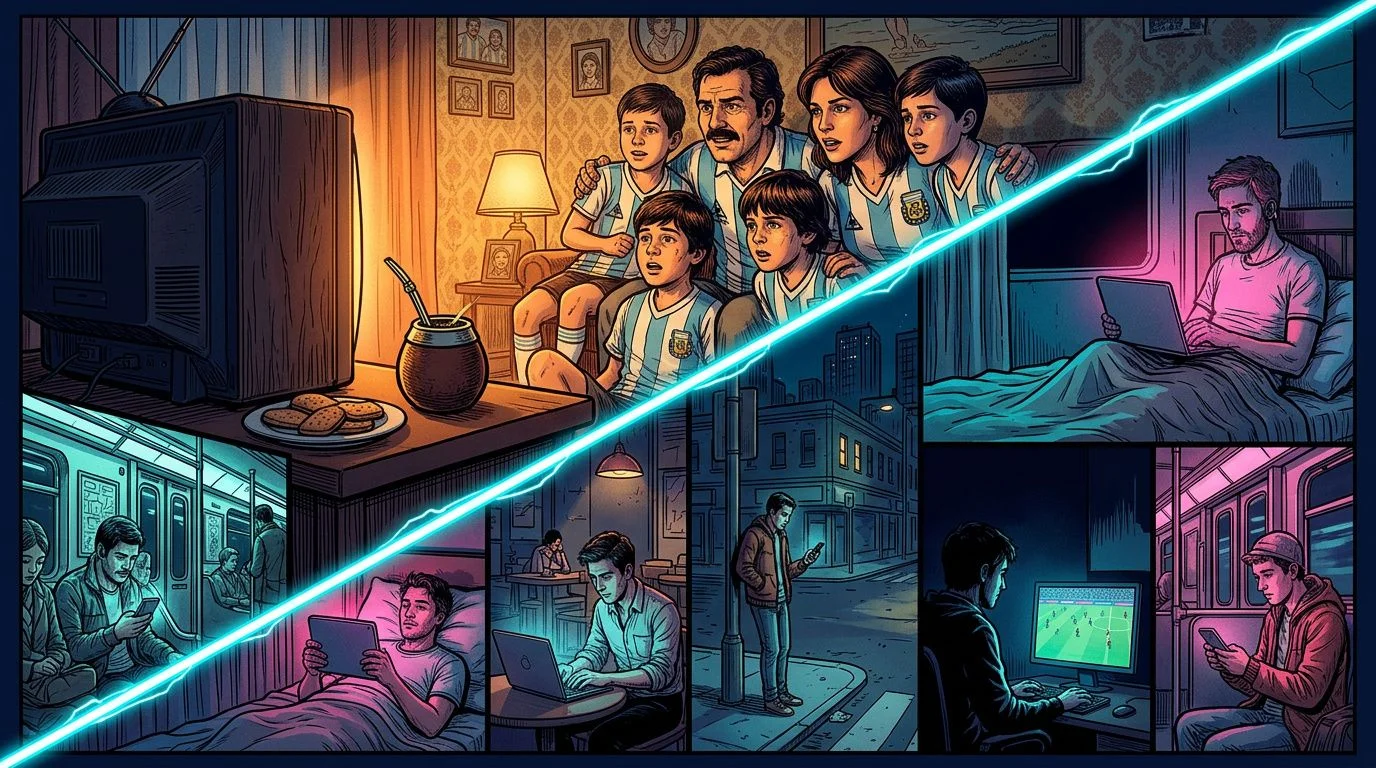
As revenues shatter ceilings, indicators of the in-person experience are collapsing. According to the American Hotel and Lodging Association (AHLA), 80% of hotels in U.S. host cities report bookings below projections. Between 65% and 70% of hoteliers attribute the decline to visa barriers, prices, and political climate.
In Mexico, the Ministry of Tourism expected 5 million tourists for the World Cup; it will receive barely 1 million. In Mexico City, on opening day hotel occupancy was 65% — classified by El Financiero as “a normal June.” A social media monitoring study from April 2026 reveals that 70% of posts about the World Cup express disenchantment, while only 4.1% of conversations are positive. The UNAM survey measured average enthusiasm at 2.57/10 in Mexican host cities.
500 million people applied for tickets, according to FIFA. But hotels are at 45% capacity. Digital demand was massive — in-person attendance, not so much.
Prices as a symptom, not the sole cause
Ticket prices went from representing 1-2 days of salary in Mexico in 1986 to years of salary in 2026 (according to Sports Illustrated México). Hotels quadrupled their rates anticipating demand that never came, as reported by Actual and Ámbito. FIFA charges a 15% commission on its own resale platform, ESPN and The Athletic revealed. Gianni Infantino defended the prices from Beverly Hills.

But it would be simplistic to blame prices alone. Most fans criticizing the World Cup today weren’t going to Qatar or Russia either. There’s model fatigue, geopolitical fatigue, algorithm fatigue. As Luis Alfonso Escudero, researcher at the Universitat de les Illes Balears, points out: “The expansion to 48 teams responds more to the logic of the market and television than to football’s traditional essence”.
World Cup business model: 1986 vs 2026
| Criterion | 1986 Mexico | 2026 Mexico/USA | Interpretation |
|---|---|---|---|
| Main source of revenue | Tickets and tourism | TV rights and sponsorships | The remote audience is worth more than the in-person one |
| Total FIFA revenues | USD ~1B estimated | USD 10.9B projected | x10 in 40 years |
| Fan experience | In-person, collective ritual | Fragmented, individual | More screens, less connection |
| Hotel occupancy | High | 45-65% | Demand does not translate into trips |
| Spontaneous enthusiasm | Very high | 2.57/10 — UNAM | Record business coincides with record apathy |
The final question
Ticket prices for the World Cup have seen a considerable increase compared to the 2022 edition in Qatar. Tickets for the final range from $2,000 to $6,370, a much higher price than the final in Doha, which was between $206 and $1,607. Hotels are at 45% capacity. Never have so many people wanted to be there — and so few been able to.
Is it a coincidence that the most lucrative World Cup in history generates the lowest spontaneous enthusiasm measured in surveys? Is there a link between optimizing the business to the limit and eroding the product that makes it possible?
The data suggest a gap between the business model and the fan experience. They have never aligned so little. Is it the model? Is it the moment? Is it my algorithm?
I don’t know. But the numbers are there.
World Cup sponsorships grew 56% in a single cycle. Enthusiasm in Mexican host cities measures 2.57 out of 10. It's not just football — music, cinema and other major spectacles face the same paradox: the more the model is optimized for business, the further it drifts from what made it special.
Sports Value / FIFA · UNAM Survey, 2026
Comments 0
Be the first to comment.