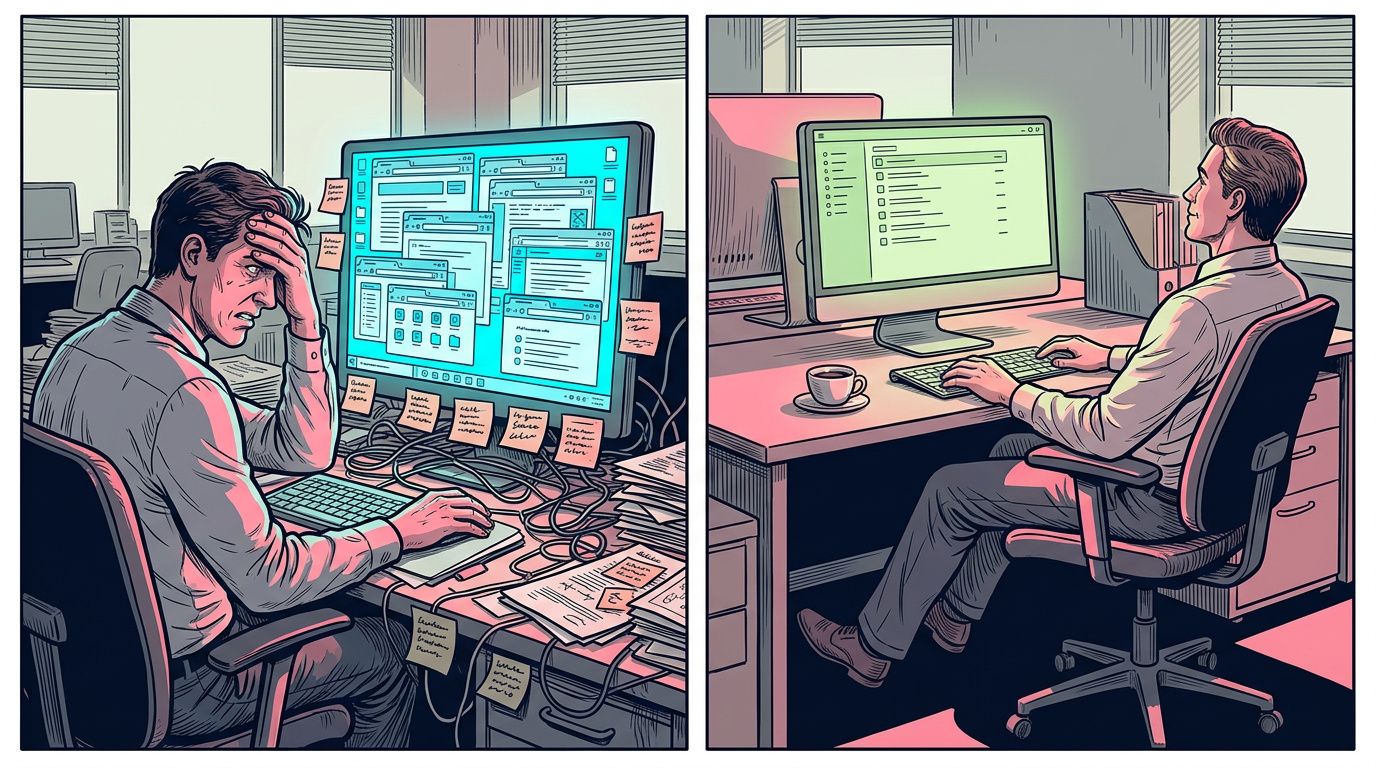
What a school, a hotel, and a construction company have in common
Three industries with no apparent connection arrive at the same problem: they depend on tools that do not belong to them. Here is the idea that connects everything I write on this blog.
The paradox of three different operations
A school managing enrollment, family communication, and academic tracking. A luxury tourism company coordinating experiences, suppliers, and high-profile clients. A group of construction companies sharing an origin but needing their own visibility. Three worlds that share neither language, metrics, nor customers.
And yet, all three ended up in the same place: building outside what their tools didn't cover, depending on solutions that never fully became their own.
The problem you see when you stop looking at the tools
Generic platforms solve for the average. Educational management software handles enrollment, but not the particular way an institution relates to its families. A booking platform works for a standard hotel, not for someone selling experiences that don't repeat. And a generic CRM records opportunities without understanding the logic by which each business decides which to attend to first.
That's where the patchwork begins. A spreadsheet nobody asked for but everyone uses. A WhatsApp flow that sustains what the system doesn't solve. A parallel dashboard where real data lives because the official software doesn't generate it. An email someone opens every morning with information that should be integrated.
Those patches are the signal that the tool doesn't belong to you. You're adapting to its limits instead of it adapting to your operation, and each patch you add increases complexity, reduces reliability, and takes time away from your team.
Digital Heritage: when owning stops being an expense
There's a fundamental difference between renting a tool and owning one. When you rent, you pay for access to something someone else designed thinking of another business. When you own, you have an asset that works exactly like yours does, and that difference is measured in who decides, never in price.
That's what I call Digital Heritage: the infrastructure that supports your real operation and belongs to you. It's the system that captures how you truly work, integrates what used to live fragmented, makes visible what was previously invisible, and evolves with your business without depending on someone else's authorization.

Education that doesn't fit in a brochure
A modern educational institution is not a catalog of programs. It's a community of families, students, teachers, and alumni, and its real operation lives in how a student enrolls, how communication with families is sustained over the years, and how the bond with those who have left is kept alive.
Generic educational management systems handle records. What an institution that wants to differentiate itself needs is a space where that community truly lives, with two-way communication and operational data—who enrolled, where they came from, how long they stay—that becomes information for growth instead of remaining in a file.
When that doesn't exist, the institution's real operation is scattered among tools that don't talk to each other, and what could be a strategic asset remains an operational expense.
The luxury tourism that lives invisible
A luxury tourism company is an expert at what it does: it designs experiences no one else could assemble, coordinates demanding suppliers, and delivers results its clients remember. But its digital presence lives on borrowed ground, appearing as a provider within a hotel's platform or as a reference within someone else's network.
Its operational excellence is invisible. Leads come by recommendation rather than through its own search, and reputation is built in private conversations no one sees from outside. When the company wants to grow, it hits the wall of not having data from its own operation, depending on third-party platforms to reach its clients, and its ability to attract is limited by systems it didn't build.
Owning would change that: it would capture that operation and turn it into a visible asset, instead of leaving it circulating in the reputation of others.
Construction that consolidated its operation
Grupo INSET is a real case in this. Four companies founded in Cancún in 1996, each specialized in a different service within construction. Historically, each company had its own digital presence, its own channels, its own identity.
What we built was a single platform that would support the four companies without erasing their identities. A shared technical foundation, integrated information, a commercial opportunity tracking dashboard that works for all, a group human resources platform. Each company keeps its brand, its site, its voice. But the real operation works like a single organism.
The result: 92% of their leads are organic. 1.5 leads per day, on the way to 2. It's operation that works, is visible, generates trust because it's documented in a system that belongs to them. It no longer depends on paid advertising. That's value.

The warning: when what sustains you doesn't belong to you
Facebook changed its reach rules without notice, and companies that had built their entire communication strategy there saw their visibility drop overnight. It was a change in the rules of the game, and none of those companies had a vote in the decision.
It wasn't Facebook's fault. It's their platform and their rules. But it's a good reminder that when your operation depends on something you don't own, you're at the mercy of decisions you don't make: a provider that changes how it connects with other systems, a feature that gets discontinued, a term of service that gets rewritten, a price that goes up because it suited someone else.
When what sustains your business doesn't belong to you, your business is fragile, even if no one around you notices until it happens.
The layer built on top of what's yours
The interesting part starts after. When you have a system that's yours and captures how your operation truly works, you can do something no generic platform allows: put artificial intelligence to work on your real data, not on an industry average. Your lead pattern, your sales cycle, the way your community moves, your retention curve, the logic by which you decide.
That layer I built as ZenReflex, and it only makes sense if there is first a system of your own to learn from. Without that, any artificial intelligence becomes generic again, even if it has better technology behind it.

What sustains your operation
Everything I write on this blog is about the same thing: the difference between adapting your business to the tools that exist and building tools that adapt to your business.
Look at the operation that sustains your company, what your team does every day, the data that matters, and the logic that defines how you grow. Does that belong to you or are you renting it? If you're renting it, you build every day on borrowed ground. If you own it, you have an asset that grows with your company.
In this blog you'll find the map by industry: education, tourism, construction, and those that will be added. Each with its own logic and its own problem, but the same underlying idea. Enter through yours.

Facebook Was Perfect Once Too.
The pattern is so predictable it has a name: enshittification. If you build your business on other people's tools, one day they will stop working for you. This is the lesson I learned from Facebook, and it applies to everything you use today.
Construiste el mejor DMC de México. ¿Tu plataforma digital lo sabe?
Varias décadas de operación, cinco divisiones, relaciones con los resorts más exclusivos del mundo. Pero cuando un travel advisor googlea, tu invisibilidad digital te cuesta el negocio. Descubre por qué una plataforma concebida para evolucionar es la decisión estratégica que diferencia a los DMC que crecen de los que se estancan.
From idea to presentation in minutes: how to make slides with Claude
You don't need complicated design tools. Learn how to ask Claude to generate professional HTML + CSS presentations, ready to use in your browser. Full control, speed, design freedom.
Comments 0
Be the first to comment.