
Beyond the Website: Custom Tools with Django
The real value of technology lies inside your business. Django goes beyond web development; it's an engine to build fully customized solutions that transform your daily operations. Discover how to identify the tool your company needs.
Sales needs data from Marketing and Operations but it always arrives late. Marketing needs feedback from Sales to adjust strategy. Operations has no visibility into what Sales will close. You sense there's a way to integrate everything. A bridge is missing. What you need is too specific to be found packaged in a generic platform.

How the Need Arises
This happens when the operation grows. With it, data gets scattered. Each department uses its own tools. They all work, but disconnected. At that point you discover there are 4 areas where you could act: Business Intelligence, HR, Project Management, Sales. In each, the solution is the same: integration.
The 3 Key Areas
BUSINESS INTELLIGENCE
Information that arrives on time, automatically, and ready to decide. Without your team having to put it together.
- Consolidate scattered data into a single dashboard
- Customized views by role (each sees their own)
- Automated weekly, monthly reports
- Clear presentation of KPIs (numbers that really matter)
- Analysis of trends and management results
- Automated market research
- Benchmarking against competitors
- Continuous monitoring of relevant online information
- Information that updates automatically without anyone copying it by hand
Today: Your data is in different places. Some in your CRM, others in spreadsheets, others in emails, others in recorded calls. Someone has to consolidate everything to make reports. The numbers you see each week require compilation tasks that sometimes aren't completed on time. Sometimes they are loaded with errors. Nobody sees clear trends.
With Django: A single reporting system where everything converges. KPIs updated automatically. Trends visible in real time. Each department sees exactly what it needs to understand. Decisions come faster, with complete information.
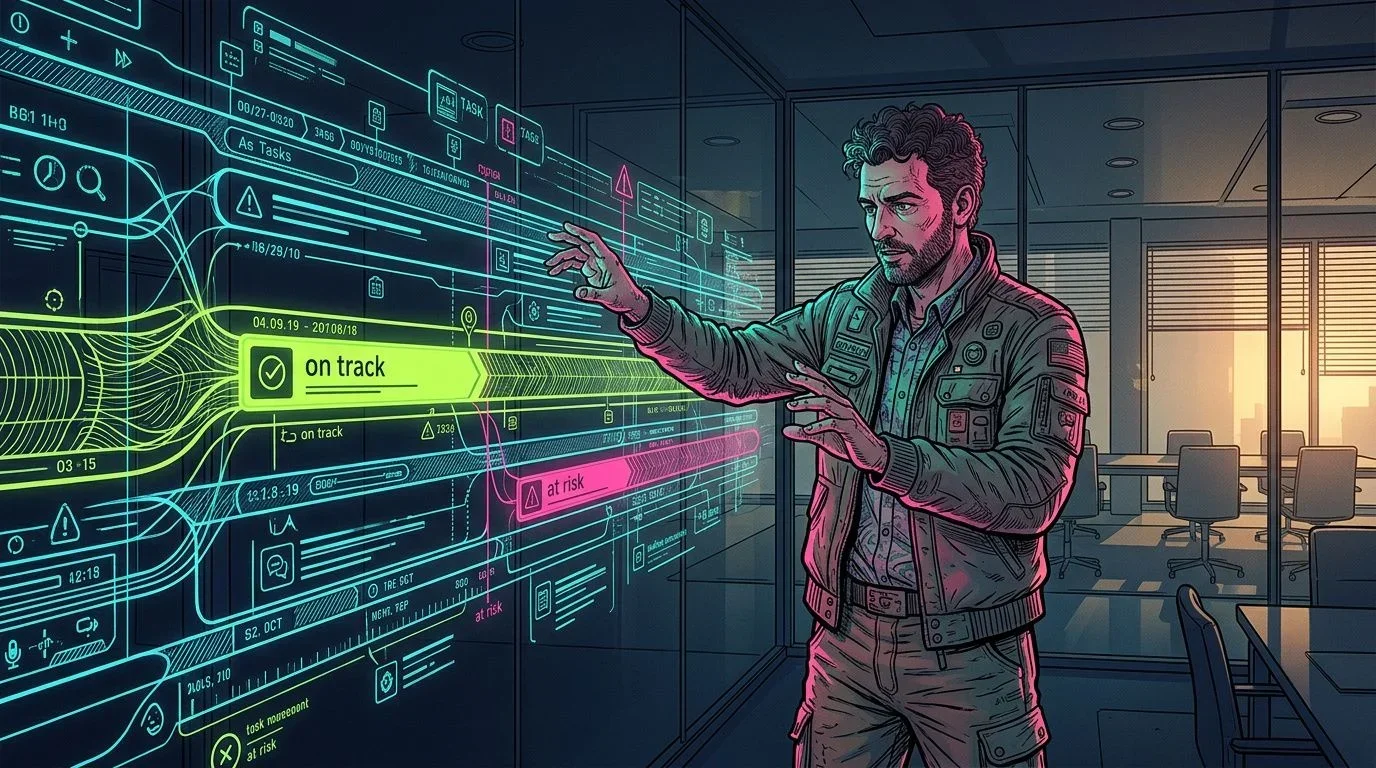
HR
Manage the full recruitment cycle without intermediaries. From posting the job to finding the right candidate, automatically.
What can be built:
- Posting job openings to multiple channels
- Automatic capture of applications
- Automatic matching between candidate profile and job requirements
- Candidate ranking based on position criteria
- Capture of spontaneous applicants that feeds the candidate database
- Automated assessments
- Scoring that prioritizes most suitable candidates
- Automated onboarding (access, tasks, documentation)
- Post-hire performance tracking
- Payroll integration
Today: You post on LinkedIn, Indeed, Facebook. Applications arrive in your email. You have to read them, compare profiles, filter manually. Some candidates will never receive feedback. Top talent gets lost because you didn't sort it in time.
With Django: You post a job once. The system distributes it automatically. It receives applications, analyzes them based on criteria, ranks candidates. You only see the top 5. The system automatically notifies those who advance and those who don't. The talent you need is prioritized from the start.
SALES / COMMERCIAL
That each lead has a clear path from entry to closure. Organized, visible, and actionable.
First stage — Flow organization:
What can be built:
- Automatic lead capture (web, forms, integrations)
- Centralized database of all your clients and prospects
- Integrated tracking: who contacted them, when, what was said
- Complete history of each opportunity
- Proposal records: sent, approved, rejected, reactivated
- Automatic follow-up notifications (no one is forgotten)
- Clear pipeline views: what stage each lead is in
- Lead management reports (conversion, cycle time, source)
- Trend analysis (which types of clients close more)
- Seasonality (when more leads arrive, when more sales close)
Second stage — Intelligent automation:
When you have a clear flow, you identify where to automate:
- Automatic responses based on query type
- Proposals generated based on client criteria
- Automatic scoring (which opportunity is most likely)
- Alerts when it's time to act
- Profitability analysis per client
Today: A lead comes in, gets lost among emails. No one knows what stage it's in. Follow-up is chaotic. Some clients are never contacted again.
With Django: Each lead has a visible path. The team knows exactly what to do and when. The flow that already works optimizes itself automatically. No invasion, no changing how they work. Just faster and without errors.
According to a McKinsey study, workers spend up to 2 hours a day searching for information. With custom integrated systems, that time drops to minutes.
Own estimate based on McKinsey Global Institute data (2019)How to Identify Your Opportunity
Which of these 4 areas is your bottleneck? Where does your team lose the most hours? Where is the information you need missing? Where are processes manual and slow?
It's probably one of these categories. And it's probably buildable.
The first step is clear: look at your actual operation. What process repeats every week? What task consumes hours? What information always arrives late? Where could your team be more agile if data were integrated?
With that clear, building is straightforward. It's translating what already exists in your head into a system that runs it automatically.
College of Civil Engineers of Cancún — Event Management
Before: Events and monthly meetings were coordinated manually. Invitations by email, confirmations via WhatsApp, phone calls without records. For each event, they had to track responses across multiple channels, without clarity on who was actually attending.
Now: Each member receives a personalized invitation. They confirm or decline attendance from a link. The system automatically stores who is coming. Reminders are sent only to those who haven't confirmed. On the event night, attendance is recorded live. The college team has complete clarity: who confirmed, who attended, who didn't show up. No more tracking emails, missed calls, or spreadsheets.
Your Next Step
With that in mind, you probably already recognize where your bottleneck is. You know which process consumes hours. You have clarity on which area your team loses time or information.
What you probably didn't know is that this can be built. That it's closer than you imagine. That it doesn't require changing how you work, but integrating what already works.
If you've followed previous v2 articles, you've already seen real examples of what this looks like implemented. It's not theory. It's real operations in companies your size.
The next step is clear: identify your first problem. The one that hurts the most. The one that costs the most. And let's talk about how to solve it.
I'm just a message away.

What a school, a hotel, and a construction company have in common
Three industries with no apparent connection arrive at the same problem: they depend on tools that do not belong to them. Here is the idea that connects everything I write on this blog.

Facebook Was Perfect Once Too.
The pattern is so predictable it has a name: enshittification. If you build your business on other people's tools, one day they will stop working for you. This is the lesson I learned from Facebook, and it applies to everything you use today.
Construiste el mejor DMC de México. ¿Tu plataforma digital lo sabe?
Varias décadas de operación, cinco divisiones, relaciones con los resorts más exclusivos del mundo. Pero cuando un travel advisor googlea, tu invisibilidad digital te cuesta el negocio. Descubre por qué una plataforma concebida para evolucionar es la decisión estratégica que diferencia a los DMC que crecen de los que se estancan.
Comments 0
Be the first to comment.