
Your business no longer needs a website. It needs a system.
When your company outgrows the digital brochure stage, generic tools become a burden. I'll show you the three real ways to build a web presence and why Django is the strategic decision to scale without relying on plugins or hidden limitations.
I discovered Django 7 years ago, while taking Harvard's CS50X and CS50W certifications. At that time, I was looking for a tool that would allow me to connect to online databases in real time to enrich my analyses, and at the same time offer an interactive, agile, and intuitive presentation of results.
Just scratching the surface of Django, I fell in love. Building a robust, advanced, and scalable platform from a directory and file structure captivated me immediately: each file was like a brick. That feeling motivated me to specialize in Django the same way I had previously done with Excel and VBA since the beginning of my career.
Since then, I've built dozens of solutions ranging from websites, payment gateways, and interactive dashboards, to my own AI Workspace where models like Claude, GPT, DeepSeek, Qwen, Nano Banana, and Flux coexist among many others and connect to my platforms to enhance them. Today I open this space to share what I've learned and connect. Welcome to v2!

The three ways to build a website (and when each one stops working)
In my experience advising companies, I see that most directors underestimate the gap between what they have and what they really need. To make informed decisions, you have to understand the three real levels of web development:
Level 1: Static pages and visual builders
Wix, Squarespace, or a WordPress without plugins. They are ideal for a restaurant that only needs to show its menu and location. The problem appears when you want that site to do something more than display information: receive payments, connect to your reservation system, or personalize the customer experience. That's when the house of cards wobbles. Many of them end up in what I call "Digital Cemeteries" and are very easy to recognize. The site adds no value, it's not designed to be updated, it stays that way forever.
Level 2: CMS with plugins
WordPress + WooCommerce, Shopify. They quickly solve a standard online store, but at the cost of depending on third-party updates, conflicts between plugins, and security you don't control. If your business handles sensitive data or unique processes, this dependency becomes a silent operational risk.
Level 3: Custom development with frameworks
Here we enter the territory of Django (Python), Laravel (PHP), or similar. There are no templates that limit your vision or plugins that dictate what can or cannot be done. A hotel can integrate check-in with its PMS and generate real-time reports for management. The flexibility is total because the code is yours. This is where the construction of the company's true "Digital Asset" begins (we will expand more on this concept in future articles).
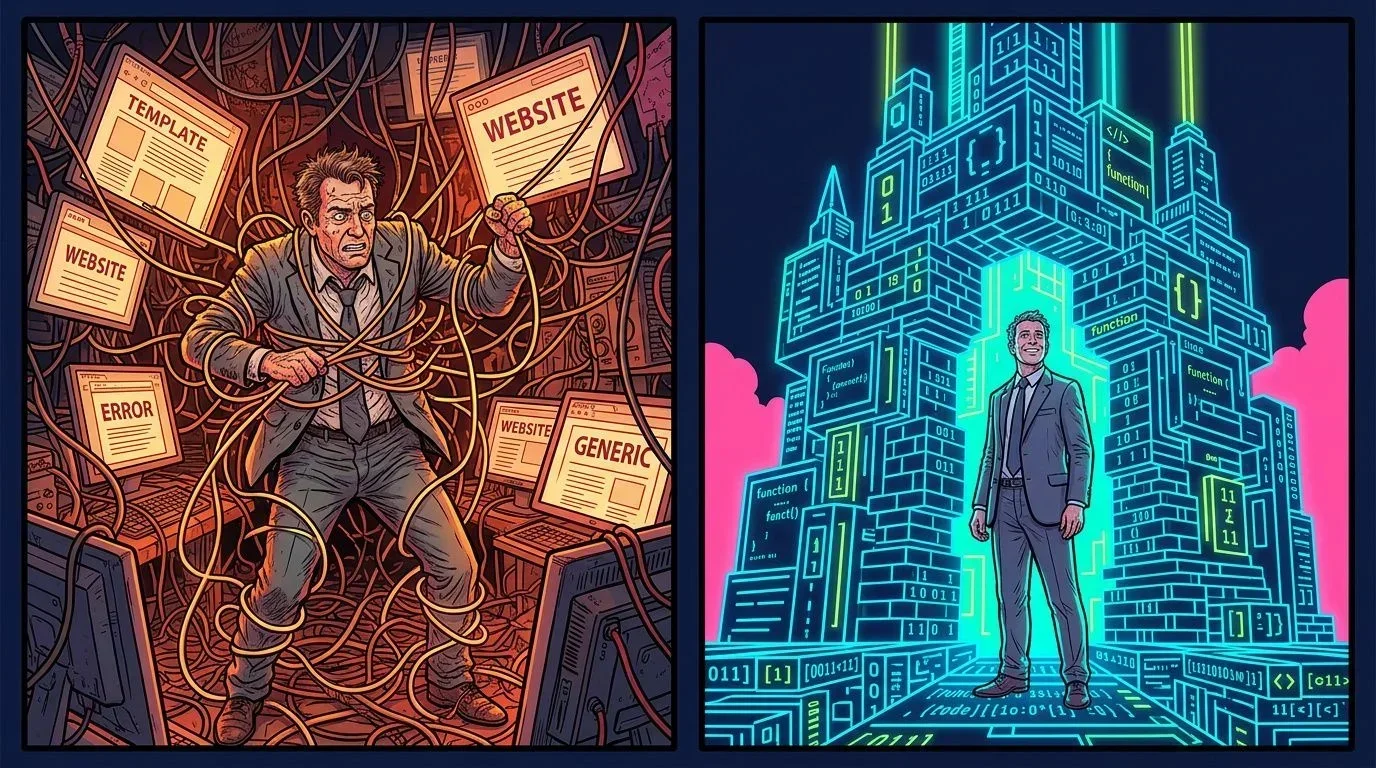
What level is your business at?
| Criterion | Level 1 · Builders | Level 2 · CMS + Plugins | Level 3 · Custom Django |
|---|---|---|---|
| Initial cost | Low | Medium | High (one-time investment) |
| Monthly maintenance | Low (as long as it doesn't grow) | Medium (risk of hidden costs) | Predictable and controlled |
| Flexibility to grow | Very limited | Limited by plugins | Total, scales with your business |
| Security | Depends on the platform | Depends on third-party plugins | Integrated and updated by the framework |
| Integrations with proprietary systems | Practically none | Only if a compatible plugin exists | Unlimited, via API or direct connections |
| Code control | None | Partial, subject to licenses | Absolute, 100% yours |
Why Django is my choice (and should be yours if you're serious)
It's not a matter of fashion. Django solves business problems that other approaches simply postpone:
• No dependency on critical plugins: Each functionality is built from scratch. If tomorrow you need your system to talk to a local payment gateway or an old ERP, we develop it without praying that a compatible plugin exists.
• Real scalability: You start with 100 users and grow to 100,000 without changing platforms. The architecture is designed for high traffic from day one.
• Security from the core: Protection against SQL injection, CSRF, and XSS built-in. You don't depend on a security plugin that updates when the developer remembers.
• Native data integration: Dashboards, real-time reports, cross-referencing information from multiple sources. If your business lives on data, Django puts it to work instead of just storing it.
• Python ecosystem: This is where Zenreflex, my own AI workspace, connects via API to enhance any platform. You can incorporate language models, predictive analytics, or automations without leaving the ecosystem.
• Maintainable code: A Django developer can read another's code and continue where they left off. There are no "black boxes" that only the original creator understands.
Absolute code control (No "Black Box"): By not using prefabricated templates, every line of code has a purpose. This allows total optimization —from technical SEO to loading speed— ensuring that nothing in the system is a mystery or a limitation.
Who is Django for in Quintana Roo?
Not all companies need this level. But in sectors where daily operations depend on precise data and unique processes, the investment pays for itself:
Hospitality: Integration with PMS, booking engines, online check-in, and real-time occupancy dashboards. You stop depending on third parties for every modification.
Construction and civil engineering: Project management, progress tracking, automatic reports for investors. Information flows without Excel spreadsheets that nobody updates.
Educational institutions: Student portals, payment management, parent communication. All centralized and with the security that minors' data demands.
Foundations and NGOs: Transparency in the use of funds, donor reports, campaign automation. You do more with less team.
Spoiler
In the next article, I'll tell the real case of one of my clients, the Cancún College of Civil Engineers: how we turned a static, hard-to-maintain website into the center of the College's marketing and communication strategy — with a news portal, sponsorship program, exclusive members area, and results that speak for themselves.
And ZenReflex, my AI workspace where multiple models coexist and connect to the platforms I develop, deserves its own space. That comes later.
If your company has already outgrown the digital brochure stage and needs a system that truly works for you, let's talk.

Education: What Your Platform Can Do When It Truly Is Yours
In the first part of this series, I talked about the problem: scattered data, manual processes, disconnected tools. Now I'll show you what the solution looks like from the inside: a proprietary platform that unifies everything your institution does, without relying on third parties.

Before you hire your next express website, read this
The invisible work that keeps your site alive after launch: security, speed, and competitive watch that no one sees but everyone feels.
Your Digital Infrastructure Journey: From Idea to Integration
Four articles, four phases. One journey: from recognizing your website isn't enough to building infrastructure that generates value. Discover which stage you're in and how to move forward.
Comments 0
Be the first to comment.